
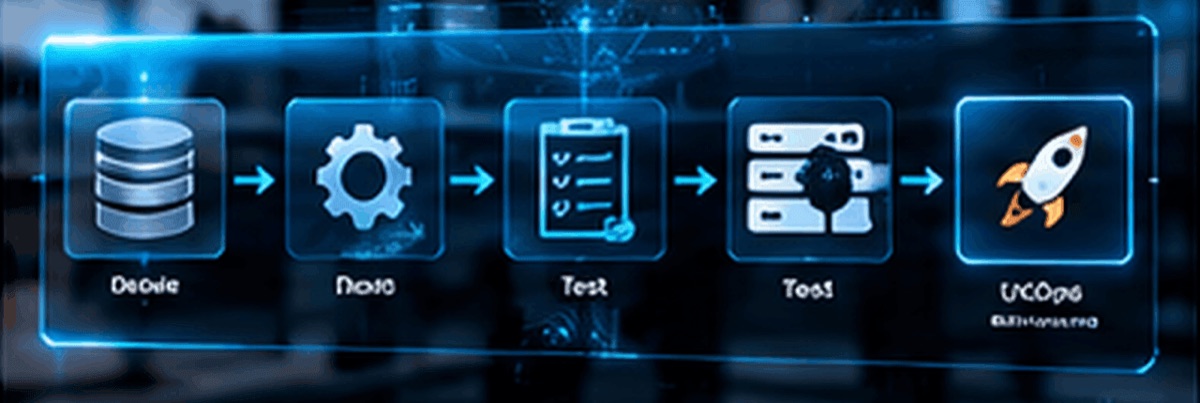
MLOps Pipelines: Automating AI Model Testing, Deployment, and Version Control
What an MLOps pipeline automates
Map experiment tracking, data validation, feature stores and deployment
A reliable approach to experiment tracking, data validation, feature stores and deployment starts by identifying the input, the expected output, and what a person should do if those two do not agree. Use a baseline that reflects real operating conditions.
Consider a data science team moving experiments into repeatable production releases. Instead of judging success by a demonstration, the ML platform team should reproduce realistic cases, record exceptions, and compare the outcome against the current process. This reduces the risk of a technically successful pilot that cannot be maintained after launch.
Separate CI, CD and continuous training
This part of the design deserves more than a configuration checkbox. Its practical value depends on the decision that follows from the result. Use a baseline that reflects real operating conditions.
For example, with a data science team moving experiments into repeatable production releases, the first version can be evaluated on a small, representative sample. The ml platform team should keep difficult cases in the test set rather than removing them because they make the results look worse. Clear acceptance criteria also make it possible to compare internal development with external tools fairly.
What to do next: The ml platform team should turn this part of the plan into a short written test, with an owner, an expected result, and a reason to revisit the decision. This is especially valuable when a pilot is handed to a separate production team.
Design reproducible training workflows
Version data, code, hyperparameters and training environments
This part of the design deserves more than a configuration checkbox. Its practical value depends on the decision that follows from the result. Use a baseline that reflects real operating conditions.
For example, with a data science team moving experiments into repeatable production releases, the first version can be evaluated on a small, representative sample. The ml platform team should keep difficult cases in the test set rather than removing them because they make the results look worse. Clear acceptance criteria also make it possible to compare internal development with external tools fairly.
Implement tests for schema, leakage and benchmark regression
For this requirement, define the situation in which it needs to work, the result that users expect, and the failure that the team intends to prevent. Use a baseline that reflects real operating conditions.
Imagine a data science team moving experiments into repeatable production releases. A pilot should include incomplete information, peak-load conditions, and a clear path back to the existing process. The strongest design makes its limitations visible before they become customer-facing incidents.
What to do next: The ml platform team should turn this part of the plan into a short written test, with an owner, an expected result, and a reason to revisit the decision. This is especially valuable when a pilot is handed to a separate production team.
Deploy models safely
Compare batch inference, real-time APIs and streaming delivery
For this requirement, define the situation in which it needs to work, the result that users expect, and the failure that the team intends to prevent. Use a baseline that reflects real operating conditions.
Imagine a data science team moving experiments into repeatable production releases. A pilot should include incomplete information, peak-load conditions, and a clear path back to the existing process. The strongest design makes its limitations visible before they become customer-facing incidents.
Use model registry, staged rollout, shadow traffic and rollback plans
In practice, model registry, staged rollout, shadow traffic and rollback plans should be translated into an observable business decision, not treated as a feature that is complete once the software is installed. Use a baseline that reflects real operating conditions.
In the case of a data science team moving experiments into repeatable production releases, a change may help one group while harming another. The ml platform team needs segmented results and a written acceptance rule. A simple decision log is often more useful than an elaborate dashboard because it connects evidence to an action.
What to do next: The ml platform team should turn this part of the plan into a short written test, with an owner, an expected result, and a reason to revisit the decision. This is especially valuable when a pilot is handed to a separate production team.
Operate and govern the pipeline
Set artifact lineage, approval gates, model access and secrets management
In practice, artifact lineage, approval gates, model access and secrets management should be translated into an observable business decision, not treated as a feature that is complete once the software is installed. Use a baseline that reflects real operating conditions.
In the case of a data science team moving experiments into repeatable production releases, a change may help one group while harming another. The ml platform team needs segmented results and a written acceptance rule. A simple decision log is often more useful than an elaborate dashboard because it connects evidence to an action.
Integrate monitoring alerts with change control and incident response
The useful question is not whether this capability exists in principle, but how the team will validate it under normal and exceptional conditions. Use a baseline that reflects real operating conditions.
Consider a data science team moving experiments into repeatable production releases. Instead of judging success by a demonstration, the ML platform team should reproduce realistic cases, record exceptions, and compare the outcome against the current process. The goal is repeatable performance under stated conditions, not a claim that the technique eliminates uncertainty.
What to do next: The ml platform team should turn this part of the plan into a short written test, with an owner, an expected result, and a reason to revisit the decision. This is especially valuable when a pilot is handed to a separate production team.
An achievable adoption roadmap
Start with a single model and minimal pipeline orchestration
The useful question is not whether this capability exists in principle, but how the team will validate it under normal and exceptional conditions. Use a baseline that reflects real operating conditions.
Consider a data science team moving experiments into repeatable production releases. Instead of judging success by a demonstration, the ML platform team should reproduce realistic cases, record exceptions, and compare the outcome against the current process. The goal is repeatable performance under stated conditions, not a claim that the technique eliminates uncertainty.
Define KPIs
A reliable approach to kPIs starts by identifying the input, the expected output, and what a person should do if those two do not agree. Use a baseline that reflects real operating conditions.
For example, with a data science team moving experiments into repeatable production releases, the first version can be evaluated on a small, representative sample. The ml platform team should keep difficult cases in the test set rather than removing them because they make the results look worse. This reduces the risk of a technically successful pilot that cannot be maintained after launch.
What to do next: The ml platform team should turn this part of the plan into a short written test, with an owner, an expected result, and a reason to revisit the decision. This is especially valuable when a pilot is handed to a separate production team.
Practical Metrics and Implementation Priorities
Illustrative numbers: If a team deploys 20 model versions in a quarter and rolls back three, its illustrative rollback rate is 15%. That number is meaningful only alongside deployment frequency, quality impact and recovery time. These values are hypothetical worked examples, not published industry averages or evidence of a typical result.
Implementation priorities
- Version datasets, features, code and models together.
- Gate promotion on reproducible tests.
- Use canary deployment and rollback triggers.
- Record model lineage and owner approvals.
What to measure before scaling
- Baseline performance and clearly defined measurement period
- Result quality and important error categories
- Operational cost, review workload and downstream impact
- Changes in metrics across customer segments and scenarios
FAQ:
1. What is an MLOps pipeline?
It is a repeatable workflow for preparing data, validating models, packaging releases, deploying them and monitoring production behavior. Automation reduces manual errors but still needs approval controls.
2. How is MLOps different from DevOps?
MLOps adds data lineage, model experiments, evaluation datasets and drift management to software release practices. A passing code test cannot guarantee model quality.
3. Why version training data?
Without a stable data snapshot, teams cannot reliably reproduce training or explain why two model versions differ. Record datasets, transformations and access permissions.
4. What belongs in a model registry?
Store version identifiers, evaluation results, training references, artifacts, ownership and release approvals. The registry should clearly indicate which model is deployed.
5. Can all models be deployed automatically?
Some low-risk models can use automated gates, but high-impact decisions may require human sign-off. Define deployment policies by risk and business criticality.
6. What is a canary model deployment?
A small portion of real traffic receives the candidate model while teams compare performance and operational behavior. Roll back if guardrails are breached.
7. How can pipelines prevent data leakage?
Enforce train-test separation by time or entity, review feature creation and test for fields that contain future information or target proxies.
8. What should trigger retraining?
A scheduled cadence, enough new labels or demonstrated performance drift can justify retraining. Every new model must still pass validation before deployment.
9. What is model rollback?
Rollback restores an approved prior version when a release causes failures. Preserve compatible features, serving configuration and artifacts so rollback remains feasible.
10. Where should a small team begin?
Automate reproducible training and a documented evaluation gate before investing in complex orchestration. Add monitoring and staged deployment next.
Key Takeaways
The best next step is to select a bounded use case, document the present workflow, and agree on the evidence that would justify expansion. For MLOps pipeline, measure outcomes that matter to users as well as technical indicators. Keep a human accountable for exceptions, and review results after the real operating environment changes.
Practical Implementation Checklist
Begin by documenting the decision this technology is meant to support. For a data science team moving experiments into repeatable production releases, specify what users submit, what they expect back, and which outcomes count as success. Keep the first test small enough to diagnose; do not begin with a company-wide rollout simply because the prototype looks promising.