
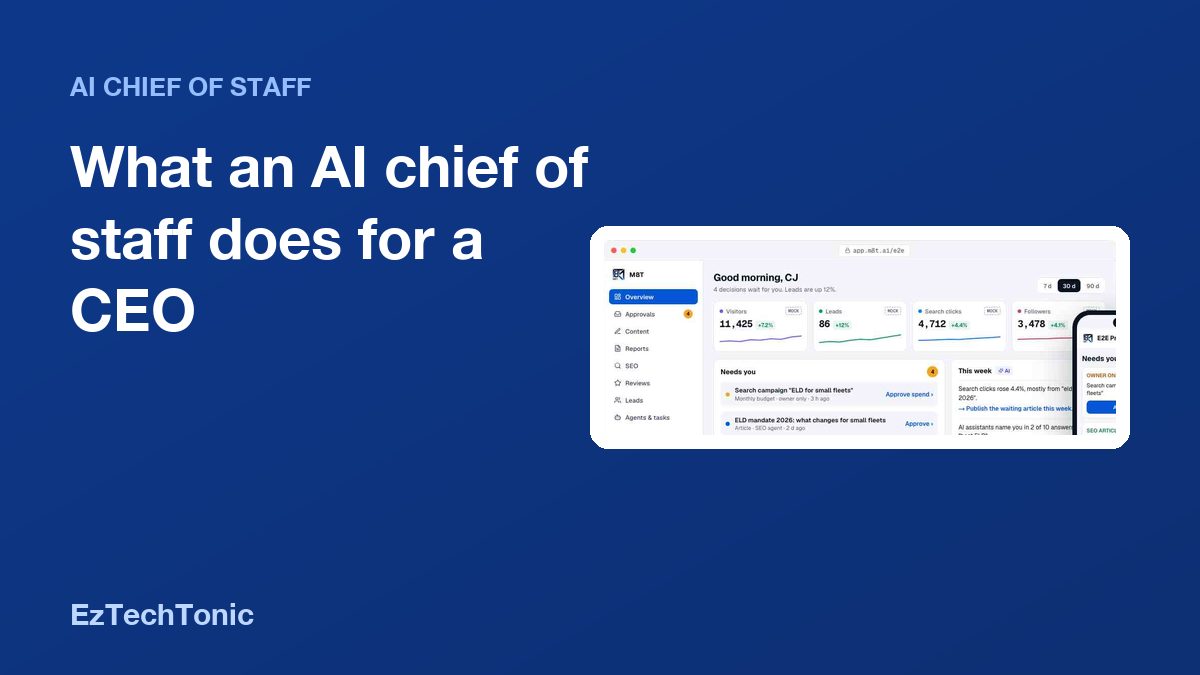
What an AI Chief of Staff Does for a CEO
Published
An AI chief of staff does the follow-up work that sits between a CEO and the company: it pulls the facts together, tells the CEO each morning what changed and what needs a decision, answers questions with the sources it used, and waits for a yes before anything risky happens. The CEO decides. The AI does the gathering, drafting and chasing.
This article explains what that looks like day to day, using the Oper8X platform and Grace, our AI chief of staff assistant, which is coming soon.
What problem does an AI chief of staff solve?
A CEO does not lack data. A CEO lacks time to find it. Customers sit in one tool, billing in another, support in a third, and the numbers that matter are spread across all of them. The usual answer is to build reports by hand and chase people for updates.
Oper8X describes the old way in four lines: you type the data in, you juggle too many tools with their own logins, you build the reports yourself, and you chase tasks by hand. The new way reverses each one. The platform pulls the data itself, runs the tasks, reports in plain words, and asks only when it needs a yes.
That is the whole idea of a chief of staff. It is not a smarter dashboard. It is someone who does the work around the decision so the CEO can spend the time on the decision.
What does an AI chief of staff do every day?
Oper8X lays the day out in four parts, and they map neatly onto what a human chief of staff does.
Morning: a brief that is already waiting
Before the day starts, the CEO gets a brief: what changed overnight and what needs them. The CEO agent in Oper8X summarises the reports from every other agent in its company and raises anything that has to go up. On the Oper8X page this is a daily and a weekly brief.
Through the day: agents work through the list
Agents hand work to each other and keep the room moving. In Oper8X these are called Agent Rooms: one agent spots a problem and passes it to the next. The CEO can watch it happen, or ignore it until the brief.
When it matters: a one-tap approval
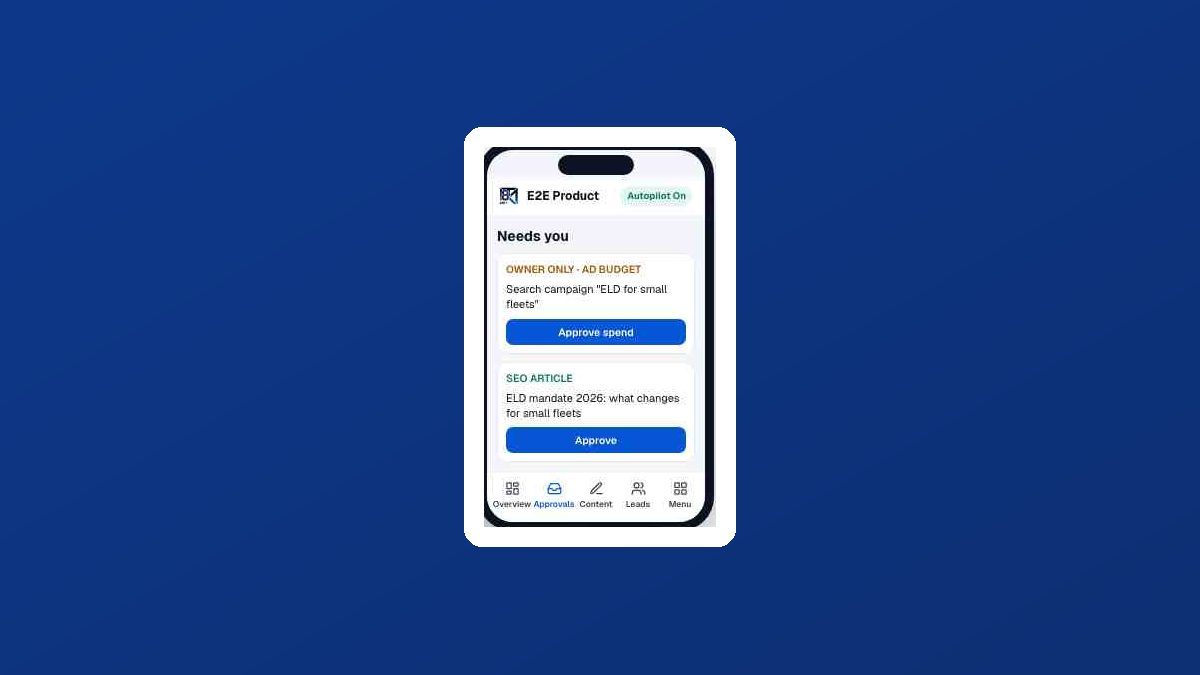
The CEO is asked only when a yes is needed. A refund, a price change, an ad budget or a release to production does not happen on its own. It waits as an approval the CEO can give in one tap.
Evening: what happened today?
At the end of the day the CEO can simply ask, and get the answer with its sources. Nobody has to compile a recap.
Can a CEO talk to an AI chief of staff?
Yes. Oper8X includes a feature called Talk to your company. The CEO can push to talk, or take a phone briefing, ask what happened today, and hear the answer with its sources. The rule printed on the page is short: voice proposes, you approve.
That rule matters. Speaking to a system is fast, and it is also easy to say something you did not mean. Because a spoken request becomes a proposal, and the CEO approves it, speed does not cost control.
Why do the sources matter?
A chief of staff you cannot check is a risk. If an assistant says revenue is down, the CEO needs to know where that came from before acting on it.
Oper8X runs on KLM, EzTechTonic’s own AI layer, and the page says every answer must cite its source. KLM can require citations: an answer that cites nothing is asked for again once and then stopped, and a stopped answer is never saved. KLM states the limit plainly. The check shows that the answer points at the sources it was given. It does not prove the sources themselves are right.
Open any action in Oper8X and you can also see the facts the agent read, the checks it passed and who approved it. That is the trail a CEO needs when a board member or an auditor asks why something happened.
How is an AI chief of staff different from other tools?
The table compares the old way of working with the way Oper8X describes itself, using the lines published on the Oper8X page.
| Task | The old way | With an AI chief of staff |
|---|---|---|
| Getting the data | You type it in | It pulls the data itself |
| Tools | Many tools, each with its own login | One platform runs the tasks |
| Reports | You build them yourself | It reports to you in plain words |
| Follow-up | You chase tasks by hand | Agents hand work to each other |
| Decisions | Mixed in with everything else | It asks only when it needs a yes |
| Checking an answer | Ask someone and wait | Answers come with their sources |
What is Grace?
Grace is our AI chief of staff assistant, coming soon. She is built to read your email, run your calendar, take your calls and tell you each morning what needs you. She does that work as an autonomous assistant, and anything risky still waits for your approval first.
Grace is not released to customers yet. When she launches, the details will be on the projects page.
Who stays in control?
The CEO does. Oper8X is built around approvals and an audit log. Every action needs a reason. Sensitive actions need a second person to approve. Every step is written to a log that can only be added to, never edited. Each agent also shows what it may do, its spend cap and an off switch, and when you switch an agent off it stops.
For the wider design question of where people belong in an AI workflow, see our article on human in the loop AI and approval workflows. For how data is protected, read how we protect data.
How would a CEO start?
- Look at the Oper8X page and decide which area hurts most: money, marketing, operations, support or tech.
- Connect the tools that hold that data. Oper8X lists payments, CRM, calendar, accounting and messaging, with keys kept in an encrypted vault.
- Read the first brief and approve or correct what the agents propose.
- Widen the work step by step as trust grows.
Questions about a project of your own? Use Start a project.
Questions and answers
What does an AI chief of staff do?
It gathers the facts, writes the morning brief, answers questions with sources, hands work between agents and asks the CEO for a yes only when one is needed.
Does an AI chief of staff make decisions for the CEO?
No. In Oper8X the agents read and propose, and people approve. Refunds, price changes, ad spend and production releases wait for a person.
Can I give instructions by voice?
Yes. Oper8X lets you push to talk or take a phone briefing, ask what happened today and hear the answer with its sources. Voice proposes and you approve.
How do I know the answers are right?
Every answer must cite its source, and you can open any action to see the facts read, the checks passed and who approved it. A source check shows the answer points at its sources, so the CEO still judges what matters.
Is Grace available now?
Not yet. Grace is coming soon. Oper8X, which carries the executive team, the briefs, voice and approvals, is described on its own page.